
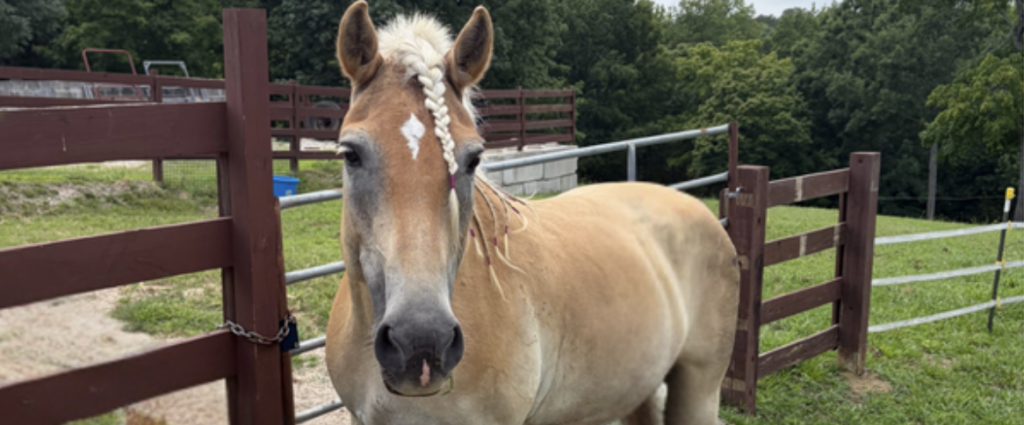
 AT HOPE REINS in Raleigh, N.C., kids wounded by loss or trauma are finding hope through a program that combines rescued horses, mentors, and faith. I’ve written about Hope Reins before and loosely base “Hope Ranch” in my SAR books on this 501c(3) organization. The work they’re doing fascinates me.
Recently I asked a friend how Hope Reins finds the rescued horses for their program and how they integrate them into the herd. Millie, the beautiful Haflinger pictured here, is the latest addition.
Elizabeth Kennon, the equine training manager at Hope Reins, kindly answered my questions. “Our primary mission,” she told me, “is to help hurting kids.” To do this best, they pick horse prospects carefully from among numerous applications.
In addition to being people-oriented, Hope Reins horses must have a rescue story in their past. Millie, for example has had several prior owners. One ran out of money for hay, so she went through a period when food was scarce. Later, she had a terrible trailer accident and was trapped for a while. It took over a year of careful, gentle rehabilitation to get her to trailer again. The horses’ rescue stories often become the connecting point with a traumatized child.
Hope Reins looks for horses in basic good health between the ages of 9 and 19. They must be rideable (that is, recently ridden) even though the program is not a riding program per se. In addition, Kennon asks “Are they curious? Are they willing to meet me halfway? I want to dialogue with them.”
Once a horse passes these initial evaluations, they enter a 90-day trial period at the ranch. “I do a lot of training,” Kennon says. “Most horses are wired to be afraid of new things. I break everything into chewable, bite-sized pieces. I establish boundaries that make it easier for them to say ‘yes.’ If I do my job well, we go from success to success to success.”
Hope Reins’ natural horsemanship methods rely on trust, communication, boundaries, and leadership to build the relationship between horse and human. These four principles are the same skills traumatized children need to learn to heal and develop resilience.
If a horse successfully gets through the trial period they are adopted by Hope Reins and become part of the program. “They have a lifetime of safety,” Kennon told me. “Once they are no longer rideable, we use them in other capacities until they retire.”
Millie was adopted into the program last week. It’s not hard to imagine that a child with a background of food scarcity or a traumatizing accident might identify with this beautiful mare. Millie’s sweet personality and gentle spirit will no doubt soon be helping heal a child’s heart.
Hope Reins was founded by faith, in the belief that Jesus Christ is the ultimate healer. They know from experience that a relationship with a horse may be just the ticket to lead a child into a relationship with the Lord. That is the hope, and that is the healing.