
 Ordinary people in the Washington D.C. area were still shaking from the 9/11 attacks when a series of letters laced with anthrax added to the community’s stress. Then, a year later, in October 2002, terror showed its face again. A sniper shooting random people doing everyday things gripped the region in fear for twenty-three days.
The D.C. sniper attacks began in Aspen Hill, Maryland, where I was raised and my parents still lived. James Martin was killed by a rifle bullet while walking into a suburban grocery store on October 2, 2002. Then, in the next two hours, four others were shot dead. One man was mowing the lawn, another filling his car with gas. A woman was reading a book, waiting for a bus, and yet another was vacuuming out her van at a Shell station.
Random people. Doing everyday things. And suddenly—gone! Killed by a bullet shot out of nowhere.
Five people in two days. And all the shootings were connected.
The region began to panic. The local police investigating the crimes were joined by state police, and then the FBI, ATF, and other federal agencies. Hundreds and hundreds of law enforcement officers soon poured over tips and shreds of evidence. Witnesses saw a white box truck. Others saw a blue car … a gray car. There were no solid leads.
Then, the sniper moved. On October 4, a woman putting purchases in the trunk of her car in the Fredericksburg, Virginia area, forty miles south of D.C., was shot in broad daylight.
Clearly no one was safe. To protect themselves, people zig-zagged through parking lots and cut their grass after dark. Gas stations shielded their pumps with tarps. School authorities eliminated outdoor activities and moved student desks away from windows, assuring parents schools were safe.
On October 7, a 13-year-old student was shot just outside his middle school.
Manassas. Ashland. Fredericksburg again. Falls Church. The siege continued until October 24, when police, using a fingerprint found at a crime scene and other evidence, identified and arrested John Allen Muhammed and 17-year-ld Lee Boyd Malvo at a rest area in Maryland, fifty miles west of D.C. In twenty-three days, ten people had been killed, three more critically wounded.
At the time of the D.C. Sniper shootings, I was working at a Fredericksburg newspaper and my husband, Larry, was working at the FBI Academy. We both followed the progress of the investigation closely. Larry actually ended up making videos for use in the trials. Both Muhammed and Malvo were found guilty. Closing this chapter in the D.C. area’s history took a lot of fine police work and multi-agency cooperation. For those who were involved, it was exhausting.
Over a decade later, I decided to write a book based on the terrifying time we’d lived through. I read police memoirs and true-crime books on the shootings and talked to some law enforcement officers who were part of the investigation.
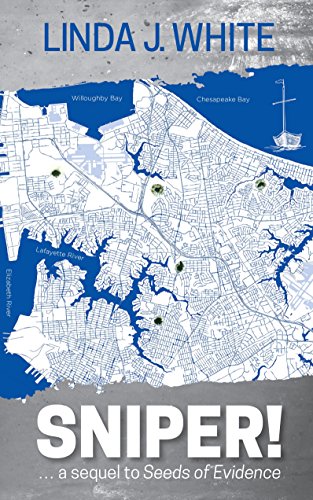
Because I wanted to use my own characters and themes, I fictionalized the story. I placed it in Norfolk and added a political twist, and yes, a little romance. But if you want to get a taste of what it felt like in the D.C. area in October 2002 and how those shootings were investigated, read Sniper!