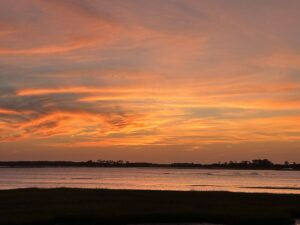
 I am in Chincoteague with my sister, Jackie, on our annual retreat. We are staying in an east-facing house overlooking Assateague Channel. The sunrises, we have found, are as varied and interesting as the sunsets. Yesterday cotton-ball clouds formed a mosaic over the brightening sky. Today, a swirl of clouds to the north provided a backdrop to the deep red sunrise. The timing is predictable far in advance, the variations of the light makes each day new.
Overlooking Assateague Channel, we watch the tides rising and falling, again so predictably. High tide will come in eight minutes, at 8:16 a.m., low tide at 2:45 p.m., high tide again at 8:44 p.m. Tides, I’m told, can theoretically be predicted centuries ahead of time. The tides and times, risings and settings are driven by the mathematical precision of God’s created order.
Sadly, this world is also subject to outbreaks of chaos. Twenty-five years ago our peace was shattered when terrorists, bent on destroying America, hijacked airliners. They flew two of them into the World Trade Center in New York and one into the Pentagon. A fourth, bound for D.C., crashed short of its target in Shanksville thanks to the bravery of passengers.
We all remember that time. The shock. The horror. The silent skies as the FAA stopped air traffic. The dust clouds billowing in New York. The gaping wound of the Pentagon. The Falling Man.
Over four thousand FBI agents and staff members responded to the attack sites. My husband worked at the FBI Academy. We knew some of those responders. They were our friends.
After 9/11 we tightened our defenses. We mourned the loss of those who died and celebrated the courage of those who acted bravely. We sang “God Bless America” over and over. And then we began to pick up the pieces.
Soon health impacts emerged among first responders: breathing difficulties, orthopedic and back injuries, mental distress. In 2010, Congress passed a bill establishing the World Trade Center Health Program designed to track these illnesses, research best practices to treat them, and provide benefits for those impacted.
No one predicted that, after the initial wave of 9/11 diagnoses died down, there would be a lull, followed by a new wave of illnesses. Twenty-five years after the attacks, cancers, breathing problems like COPD, muscular disorders, auto-immune diseases, and in some cases, early dementia are exploding among those who breathed the toxic dust and the poisoned air created by pulverized buildings, jet fuel, and smoke.
The numbers are rising dramatically: 9/11-related lung cancer cases have doubled in the last five years. First responders with no family history are coming down with bladder and thyroid cancers or a rare form of blood cancer. Aero-digestive disorders like sleep apnea and GERD and asthma appear in higher-than-average numbers among that cohort.
Over four hundred FBI agents and staff are now dealing with 9/11-related diseases. One is a close friend. Twenty-five years ago she responded to and served at the Pentagon crash site. Today, she is courageously battling 9/11-related Stage IV cancer.
We are not finished with the impacts of the 9/11 attacks. Our friends and neighbors, responders and survivors, are still suffering. And so, we remember.
The sun rises and sets. The tides come and go. The God who has ordered the Universe has made other promises as well, namely, chaos will eventually be defeated, and those who believe in Him will live forever with Him. Those promises are as trustworthy and true as the times and tides.